
Category
Category
IMS Internal Auditor Training-ISO 9001:2026, ISO 14001:2026 and ISO 45001:2018
This three-day course prepares participants to plan, conduct, report and follow up integrated internal audits of a management system covering quality (ISO 9001:2026), environment (ISO 14001:2026) and occupational health and safety (ISO 45001:2018). It follows the ISO 19011 audit guidelines and includes the key changes in the 2026 editions of 9001 and 14001. Learning is practical, built around case studies, finding-writing workshops and a mock audit.


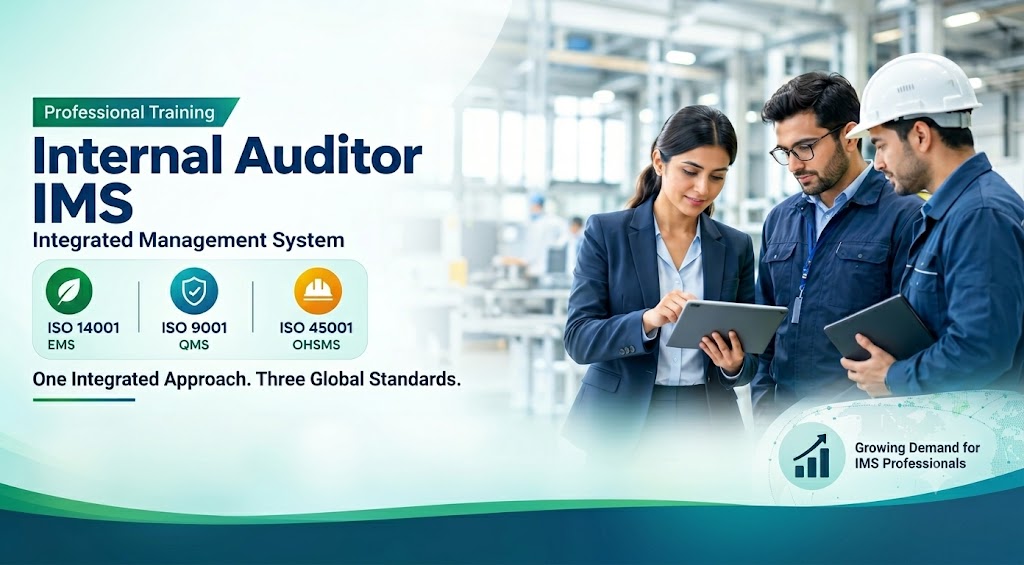
This three-day course prepares participants to plan, conduct, report and follow up integrated internal audits of a management system covering quality (ISO 9001:2026), environment (ISO 14001:2026) and occupational health and safety (ISO 45001:2018). It follows the ISO 19011 audit guidelines and includes the key changes in the 2026 editions of 9001 and 14001. Learning is practical, built around case studies, finding-writing workshops and a mock audit.
- Basic familiarity with at least one of the three standards (recommended, not mandatory)
- Working knowledge of your organisation’s processes and documentation
- No prior auditing experience needed
- Participants should bring a copy of the standards if available
- Audit principles, types and the audit lifecycle (ISO 19011)
- The shared high-level structure (clauses 4-10) and integrated auditing by process
- What’s new in ISO 9001:2026 and ISO 14001:2026, including climate change, separate risks and opportunities, quality culture and ethics
- Standard-specific requirements for quality, environmental aspects and compliance obligations, and OH&S hazards, worker participation and incident investigation
- Audit planning, checklists, interviewing, evidence gathering and sampling
- Writing nonconformities, reporting, corrective action and effectiveness verification
- Internal auditors and auditor candidates
- Quality, environment, health and safety (QHSE) professionals
- Management representatives and process owners
- Managers and supervisors who support or are audited under the IMS
- Professionals transitioning from the 2015 editions of 9001 and 14001
Participants who complete the course and pass the assessment receive a Certificate of Competence as an IMS Internal Auditor . Attendance of at least 90% is required. This is an internal-auditor qualification, not an accredited lead auditor certification (e.g. IRCA or CQI).
- Format: Online
- Exam Type: Mixed (Descriptive & MCQ)
- Total Marks: 100
- Pass mark: 70
- Total Duration: 2 hours
- Total Questions: 4 sections
Do I need to know all three standards?
No. The course teaches the shared structure and then each standard’s specific requirements.
I’m certified to the 2015 editions. Is this still relevant?
Yes. The course covers the changes and how they affect audits during your transition period.
Is this course accepted for external certification audits?
It qualifies you for internal audits. Lead auditor registration needs an accredited course.
Is the training online or in person?
Both can work. Online delivery is typically split into three half-day sessions.
IMS Lead Auditor Course Outline (3 Days)
ISO 9001:2026, ISO 14001:2026 and ISO 45001:2018
Duration: 3 days (about 24 hours)
Level: Lead auditor for first-, second- and third-party audits
References: ISO 19011, ISO/IEC 17021-1
Objectives
By the end, participants can:
- Plan, lead, report and follow up an integrated audit
- Apply the requirements of all three standards, including the 2026 changes in 9001 and 14001
- Gather evidence, write clear findings and reach audit conclusions
- Lead an audit team and manage the auditee relationship
Delivery Note
Three days is compressed for a full lead auditor course. This outline works best if participants complete pre-course study of the three standards (about 6-8 hours) and already know their basic requirements. If not, a 5-day format is the safer choice.
Day 1: Foundations and Requirements
| Session | Topic |
|---|---|
| 1 | Welcome, objectives and the management system approach |
| 2 | High-level structure (clauses 4-10), PDCA and key terms |
| 3 | What’s new: 9001:2026 and 14001:2026 changes (climate change, risks vs opportunities, quality culture and ethics, stakeholder expectations) and 45001 context |
| 4 | Audit principles, types and the certification process (ISO 19011, 17021-1) |
| 5 | Requirements clauses 4-7: context, leadership, planning, support, with Q/E/OH&S specifics |
| 6 | Workshop: Interpreting requirements and identifying evidence |
Day 2: Planning and Conducting the Audit
| Session | Topic |
|---|---|
| 1 | Audit program, initiating the audit and document review |
| 2 | Audit plan, team roles and working documents |
| 3 | Opening meeting and communication |
| 4 | Evidence gathering: interviewing, observation, sampling and audit trails |
| 5 | Requirements clauses 8-10: operation, performance evaluation, improvement |
| 6 | Workshop: Prepare an integrated audit plan and run a role-play audit |
Day 3: Findings, Reporting and Examination
| Session | Topic |
|---|---|
| 1 | Findings and grading nonconformities (requirement, evidence, gap) |
| 2 | Workshop: Nonconformity writing |
| 3 | Audit conclusions, closing meeting and audit report |
| 4 | Corrective action, effectiveness verification, surveillance, recertification and transition audits |
| 5 | Auditor competence, ethics and impartiality |
| 6 | Course review and examination |
- Download the exam course outine
The course highlights:
- Duration 24 hrs
- Language English
- Level Beginner Level
- Mode Online/ Corporate