


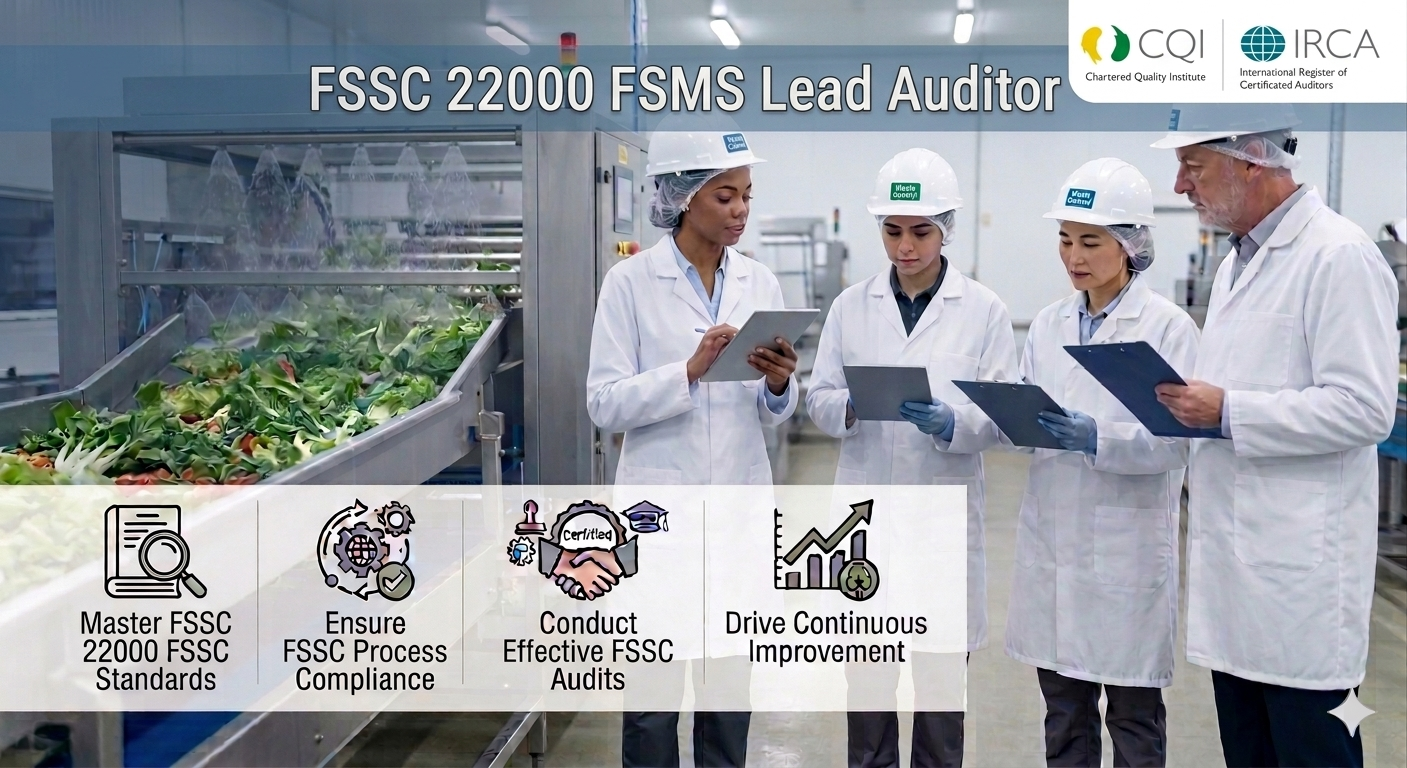
This intensive 5-day (40-hour) program focuses on the integration of ISO 22000 with the HACCP (Hazard Analysis and Critical Control Points) principles defined by the Codex Alimentarius. It teaches auditors how to evaluate a Food Safety Management System (FSMS) based on the “High-Level Structure” (HLS) and risk-based thinking.
Key Learning Objectives:
- HACCP Mastery: Auditing the effectiveness of Hazard Analysis and CCP controls.
- FSMS Principles: Evaluating the interaction between Prerequisite Programs (PRPs), Operational PRPs, and Critical Control Points.
- Audit Leadership: Managing a multi-disciplinary audit team in a complex food manufacturing or processing environment.
- Context of the Organization: Assessing how external issues (like supply chain disruptions) impact food safety.
The New Version: ISO 22000 & FSSC 22000 V7 (2026)
The food safety landscape is currently shifting. While the ISO 22000:2018 base remains, a significant update is occurring through FSSC 22000 Version 7, expected in Q2 2026.
New Course Contents & Upcoming Changes:
- Climate Action (Amendment 1): Mandatory auditing of how climate change impacts food safety risks (e.g., heatwaves affecting cold storage).
- ISO 22002:2025 Series: Transitioning from older PRPs to the new 2025 consolidated series for industry-specific hygiene practices.
- Sustainability & UN SDGs: Integrating environmental and social sustainability goals into the food safety culture.
- Advanced Traceability: Stricter requirements for real-time digital traceability and rapid “mock recall” performance.
- Food Defense & Food Fraud: Enhanced scrutiny on the prevention of intentional contamination and economically motivated adulteration.
CQI-IRCA requires delegates to have foundational knowledge before attending the Lead Auditor course:
- Knowledge of ISO 22000: Understanding the requirements of the 2018 standard.
- HACCP Principles: A solid grasp of the 7 HACCP principles and 12 implementation steps.
- Industry Experience: Basic understanding of food industry “Good Practices” (GMP, GHP, GAP, etc.).
- Management Systems: Familiarity with the Plan-Do-Check-Act (PDCA) cycle.
The training covers the full FSMS audit life cycle:
- Audit Initiation: Determining the audit scope relative to the food chain category (e.g., Processing, Packaging, Catering).
- Document Review: Validating the Hazard Analysis and the FSMS manual.
- On-site Audit: Conducting opening meetings, performing “site walkthroughs” to check hygiene/PRPs, and interviewing top management.
- Audit Reporting: Grading non-conformities (NCRs) that could lead to food safety failures.
- Closing & Follow-up: Evaluating the effectiveness of corrective actions and mock recall results.
- Food Safety Managers & Quality Assurance (QA) Leads: Responsible for maintaining FSMS certification.
- HACCP Team Leaders: Looking to advance their career into professional auditing.
- Food Industry Consultants: Advising clients on ISO 22000 or FSSC 22000 implementation.
- Supply Chain Auditors: Evaluating the food safety standards of vendors and raw material suppliers.
- Health & Regulatory Inspectors: Professionals from government food safety bodies (like FSSAI or FDA).
- Certificate of Achievement: Awarded upon passing the continuous assessment and the IRCA final exam.
- IRCA Registration: This certificate is the core requirement to register as a Food Safety Lead Auditor on the International Register of Certificated Auditors.
- Global Recognition: The credential is valid worldwide and is often a mandatory requirement for auditors working for top-tier Certification Bodies.
Q: How is the exam conducted?
A: Most CQI-IRCA exams are now online proctored. It is a restricted open-book exam involving case studies based on food safety scenarios.
Q: Does this course cover FSSC 22000?
A: Yes, most modern ISO 22000 courses are built to cover the “Additional Requirements” of FSSC 22000, as it is the most common scheme used by global manufacturers.
Q: Is there a transition period for the new 2026 updates?
A: Yes, once FSSC 22000 V7 is released, organizations typically have a 12-month transition period to upgrade their systems and auditors to the new version.
Q: Can I take this course if I don’t work in a food factory?
A: Yes, the standard applies to any organization in the food chain, including equipment manufacturers, packaging producers, and logistics providers.
Module 1: The Food Safety Management Framework
Module 2: Auditing HACCP & Technical Controls
Module 3: Audit Leadership & Planning (ISO 19011)
Module 4: Executing the Food Safety Audit
Module 5: Reporting, Non-Conformity, & Improvement
- Download the exam course outine