


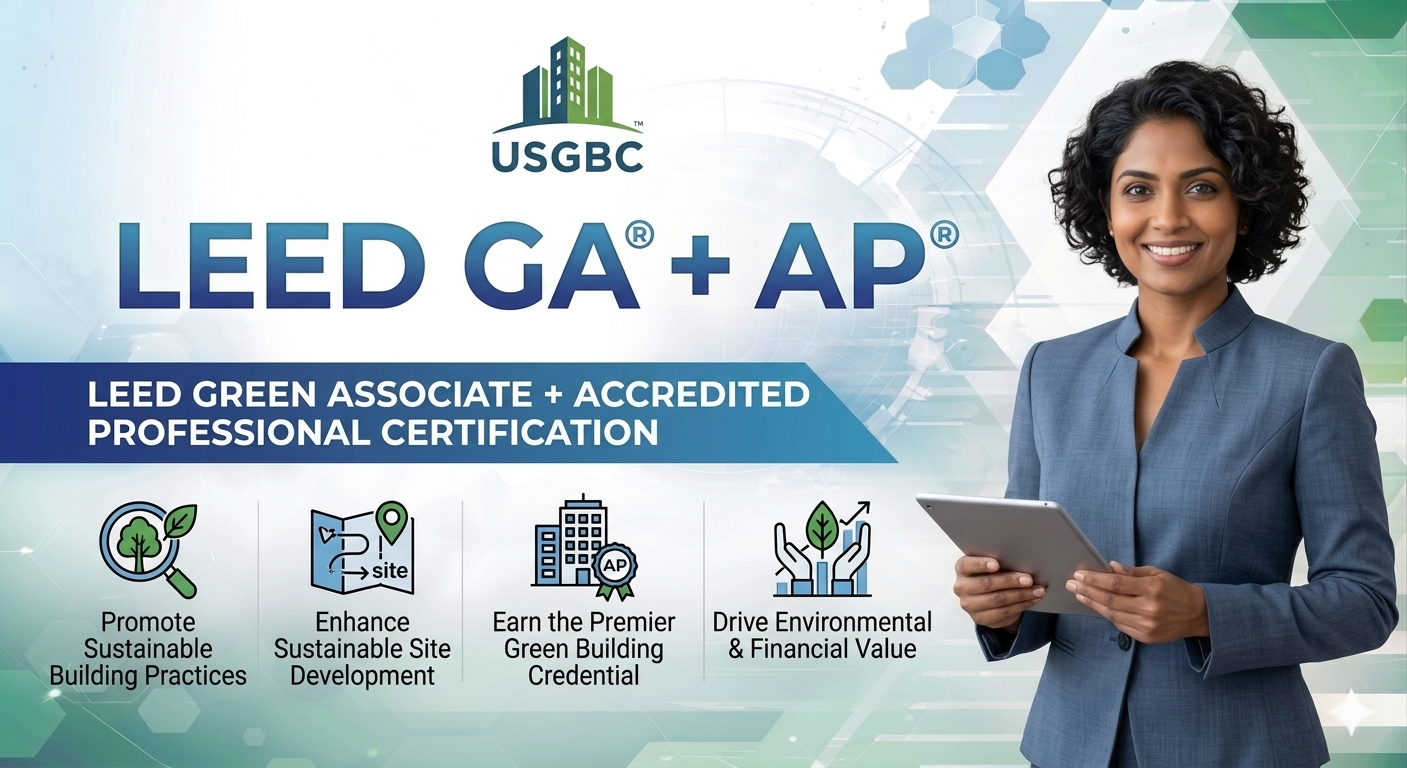
The training is divided into two distinct tiers:
- LEED Green Associate (GA): The entry-level tier. It covers the “triple bottom line” (people, planet, profit) and the core principles of green building, including site selection, water efficiency, and energy use.
- LEED Accredited Professional (AP) with Specialty: The advanced tier. It focuses on the practical application of LEED rating systems. You must choose a specialty such as BD+C (Building Design + Construction), ID+C (Interior Design + Construction), or O+M (Operations + Maintenance).
The requirements differ significantly by level:
Level | Requirements |
LEED Green Associate | No formal requirements. It is recommended to have exposure to green building concepts or attend a recognized training program. |
LEED AP with Specialty | You must hold a valid LEED Green Associate credential. Additionally, you should have experience working on a LEED-registered project (though not strictly audited, it is essential for the exam). |
The training covers the LEED v4.1 framework (the most current version in 2026), focusing on these key categories:
- Integrative Process: Collaborative team approach to project goals.
- Location and Transportation: Reducing the environmental impact of vehicle use.
- Sustainable Sites: Minimizing impact on ecosystems and water resources.
- Water Efficiency: Indoor and outdoor water reduction.
- Energy and Atmosphere: Energy performance, renewables, and refrigerant management.
- Materials and Resources: Life-cycle impact and waste management.
- Indoor Environmental Quality: Air quality, thermal comfort, and lighting.
- Architects and Interior Designers: To lead sustainable design initiatives.
- Engineers (Civil, Mechanical, Electrical): To optimize building performance and systems.
- Construction Managers & Contractors: To implement green building practices on-site.
- Real Estate Professionals & Facilities Managers: To improve asset value and operational efficiency.
- Students & Graduates: To gain a competitive edge in the global job market.
Upon passing the exams, you receive credentials from GBCI (Green Business Certification Inc.):
- Credential 1: LEED Green Associate.
- Credential 2: LEED AP (with your chosen specialty suffix, e.g., LEED AP BD+C).
- Maintenance: * GA: 15 Continuing Education (CE) hours every 2 years.
- AP: 30 Continuing Education (CE) hours every 2 years (6 must be specialty-specific).
Note: Fees are lower for employees of USGBC member companies.
Fee Type | USGBC Member | Non-Member |
LEED Green Associate Exam | $200 USD | $250 USD |
LEED AP Specialty Exam | $250 USD | $350 USD |
Combined (GA + AP) Exam | $400 USD | $550 USD |
Pro-Tip: The “Combined Exam” allows you to take both the GA and AP tests in one four-hour session. If you fail the AP portion, you still earn the GA credential if you passed that section.
Q: Can I take the LEED AP exam directly?
A: No. You must pass the LEED Green Associate exam first. You can, however, schedule them on the same day as a “Combined Exam.”
Q: How many questions are on the exams?
A: Both the GA and the AP exams consist of 100 multiple-choice questions each. You are given 2 hours for each part.
Q: Is the LEED exam based on memorization?
A: The GA exam requires a mix of memorization and understanding of concepts. The AP exam is heavily situational, testing your ability to apply LEED credits to specific project scenarios.
Q: What is a passing score?
A: The passing score for all LEED exams is 170 on a scaled range of 125 to 200.
Q: Are there remote testing options?
A: Yes, GBCI offers online proctored exams through Prometric, or you can visit a physical testing center.