


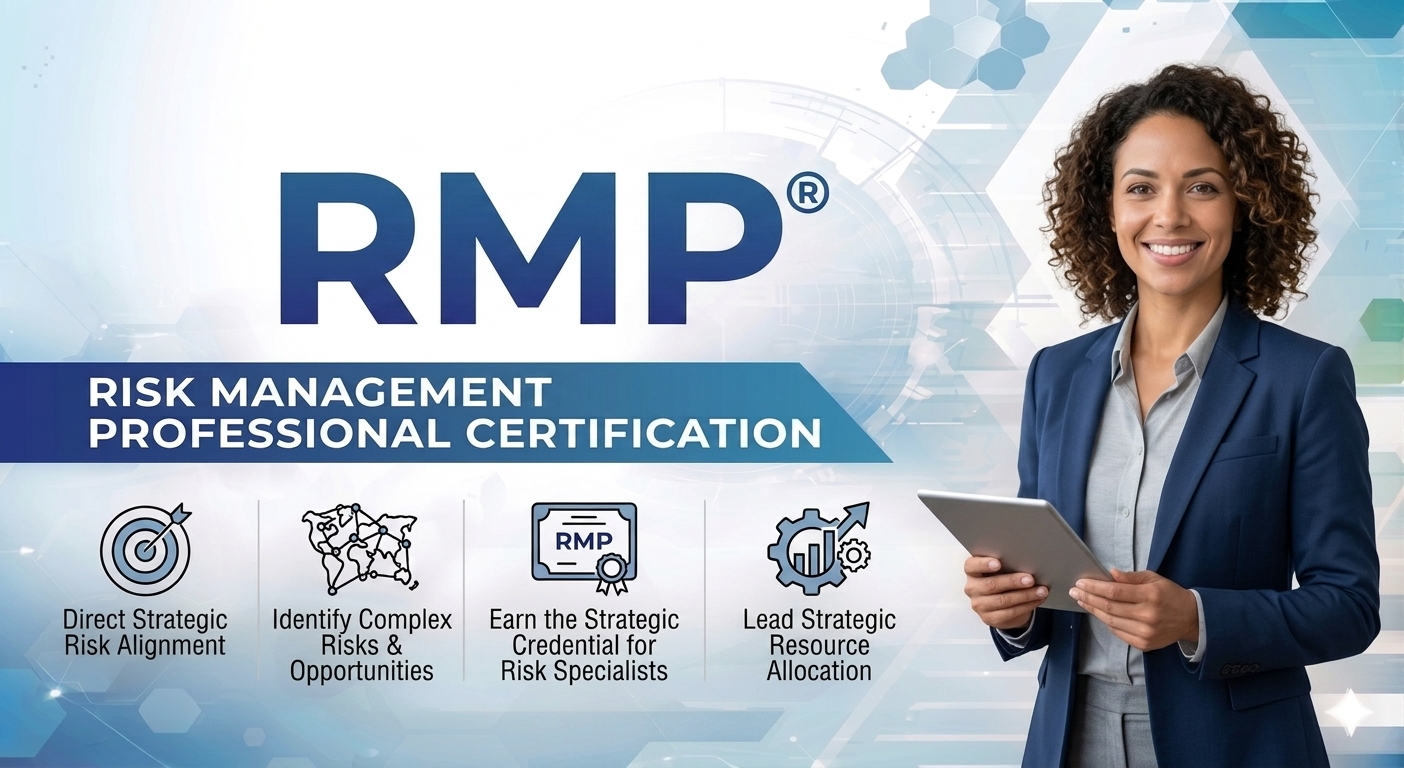
The PMI-RMP training is designed to provide a deep dive into the framework of risk management based on the PMBOK® Guide and the Standard for Risk Management in Portfolios, Programs, and Projects. The course focuses on moving beyond simple “firefighting” to a structured approach of quantitative and qualitative risk analysis.
Key Learning Objectives:
- Developing a Risk Management Plan.
- Mastering risk identification techniques (SWOT, Delphi, Root Cause).
- Performing Qualitative and Quantitative Analysis (Monte Carlo simulations, Decision Trees).
- Planning and implementing risk responses.
To sit for the PMI-RMP exam, you must meet one of the following sets of requirements:
Education Background | Project Risk Management Experience | Project Risk Management Education |
Secondary Degree (High School, Associate Degree) | 36 months within the last 5 years | 40 contact hours |
Four-Year Degree (Bachelor’s or Global Equivalent) | 24 months within the last 5 years | 30 contact hours |
The scope of the training covers the five primary domains defined by PMI:
- Risk Strategy and Planning: Defining risk thresholds and the management framework.
- Risk Identification: Uncovering potential events that could impact project objectives.
- Risk Analysis: Assessing the probability and impact of risks.
- Risk Response: Developing strategies (Avoid, Transfer, Mitigate, Accept/Exploit, Share, Enhance).
- Monitor and Close Risks: Tracking existing risks and identifying new ones throughout the project lifecycle.
This course is ideal for professionals who are responsible for identifying, assessing, and capturing risk across large-scale projects, including:
- Project and Program Managers
- Risk Management Consultants
- Line Managers
- Project Coordinators and Analysts
- Professionals aiming to transition into specialized risk roles.
5. Certifications
Upon successful completion of the training and passing the PMI exam, you are awarded the PMI Risk Management Professional (PMI-RMP)® designation.
- Maintenance: To maintain the certification, you must earn 30 Professional Development Units (PDUs) in risk management topics every three-year cycle.
Fees are subject to change by PMI. Below are the standard global rates:
- PMI Member Fee: $520 USD
- Non-Member Fee: $670 USD
- PMI Membership: Approximately $129 USD/year (plus a $10 application fee).
- Note: It is usually more cost-effective to become a member before paying for the exam.
Q: How long is the PMI-RMP exam?
A: The exam consists of 115 multiple-choice questions and you have 2.5 hours to complete it.
Q: Is the RMP harder than the PMP?
A: It isn’t necessarily “harder,” but it is much more specialized. While the PMP covers a broad range of project areas, the RMP requires a deeper technical understanding of mathematical risk modeling and analysis.
Q: Can I take the exam online?
A: Yes, PMI offers the option to take the exam via an online proctored testing (OPT) environment or at a physical Pearson VUE testing center.
Q: Does the training include the “contact hours” required for the application?
A: Yes, standard PMI-RMP training programs are designed to provide the 30–40 contact hours needed to qualify for the exam.