


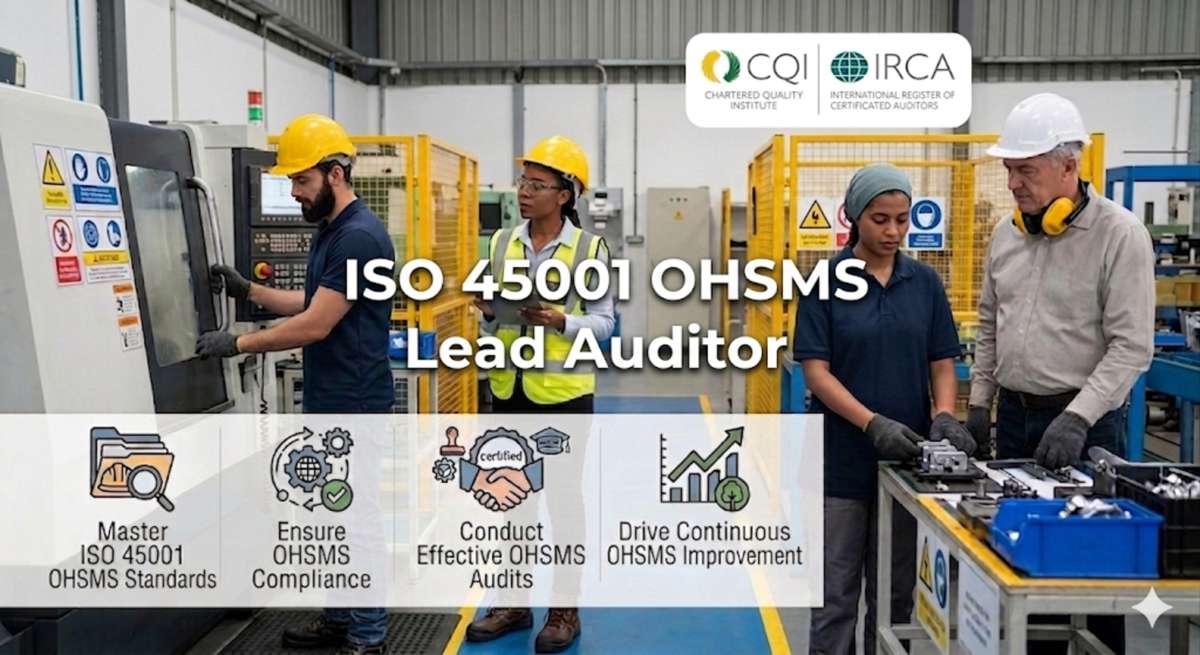
This 5-day (40-hour) intensive program is based on the ISO 19011 and ISO 17021 auditing guidelines. It transitions safety professionals from simply “managing” hazards to “auditing” the effectiveness of an entire management system, focusing on leadership commitment and worker participation.
Key Learning Objectives:
- Hazard Identification & Risk Assessment: Auditing the core of the OHSMS.
- Legal Compliance: Evaluating how an organization identifies and meets its OHS legal obligations.
- Audit Management: Planning and leading an audit team through a complex site audit.
- Non-Conformity Grading: Distinguishing between system failures and isolated incidents.
The Upcoming Version: ISO 45001:2027
The ISO 45001 standard is currently entering a formal revision cycle. While the 2018 version remains the gold standard, ISO 45001:2027 is scheduled for release in early 2027.
Anticipated Course Content Changes:
- Psychosocial Health & Wellbeing: Massive shift toward auditing mental health, stress, burnout, and workplace harassment.
- Climate Resilience: Integrating climate change risks (heat stress, extreme weather) into the OHS risk assessment process.
- Diversity, Equity, & Inclusion (DEI): Recognizing DEI as a fundamental component of a safe and supportive workplace culture.
- Technological Integration: Auditing the use of wearable safety tech, AI-driven risk monitoring, and remote auditing tools.
- Enhanced Contractor Oversight: Stronger requirements for managing the safety of outsourced workers and supply chain partners.
Delegates are expected to have a foundational understanding of OHS concepts before attending:
- Knowledge of ISO 45001: Familiarity with the requirements of the ISO 45001:2018 standard.
- OHS Principles: Understanding the concepts of hazard identification, risk assessment, and the hierarchy of controls.
- Management Systems: Awareness of the Plan-Do-Check-Act (PDCA) cycle and High-Level Structure (HLS).
The training follows the complete audit lifecycle for a safety-critical environment:
- Stage 1 Audit: Assessing system readiness and documentation.
- Stage 2 Audit: Evaluating the implementation and effectiveness of OHS controls on-site.
- Worker Consultation: Auditing the engagement of non-managerial workers (a unique ISO 45001 requirement).
- Reporting: Presenting findings that lead to meaningful safety improvements.
- Audit Follow-up: Verifying that corrective actions have effectively mitigated safety risks.
- Health & Safety Managers/Officers: Those overseeing OHSMS implementation.
- Environmental Health and Safety (EHS) Leads: Responsible for integrated management systems.
- Safety Consultants: Advising organizations on OHS compliance and certification.
- Aspirant External Auditors: Individuals seeking to work for accredited Certification Bodies.
- Internal Audit Team Leaders: Enhancing their internal auditing program.
- Certificate of Achievement: Awarded after successfully passing the continuous assessment and the final exam.
- IRCA Registration: This certificate satisfies the formal training requirement to register as an OHSMS Lead Auditor with CQI-IRCA.
- Professional Standing: Internationally recognized, allowing you to audit anywhere in the world under the IRCA banner.
Q: How long is the exam?
A: The CQI-IRCA exam is typically 1 hour and 45 minutes, conducted in an online proctored, open-book format.
Q: Is this course equivalent to OHSAS 18001?
A: No. OHSAS 18001 has been withdrawn. ISO 45001:2018 is the current international standard that replaced it.
Q: If I take the 2018 training now, will it be valid in 2027?
A: Yes. After the 2027 version is released, there is a 3-year transition period. You will only need to complete a short “Transition Training” module to update your credential to the new version.
Q: Does this course teach me how to be a Safety Officer?
A: No, it teaches you how to audit a Safety Management System. It assumes you already understand the basics of being a safety professional.
Q: Can I audit for a Certification Body after this course?
A: This course provides the educational qualification. To audit for a Certification Body, you will also need to complete a specific number of supervised audit days.
Module 1: The OHSMS Framework & Culture
Module 2: Auditing Planning & Hazard Control
Module 3: Auditing Operational Controls & Emergency Response
Module 4: Lead Auditor Competencies & ISO 19011 Application
Module 5: Performance Evaluation, Reporting & NCRs
- Download the exam course outine