
Category
Category
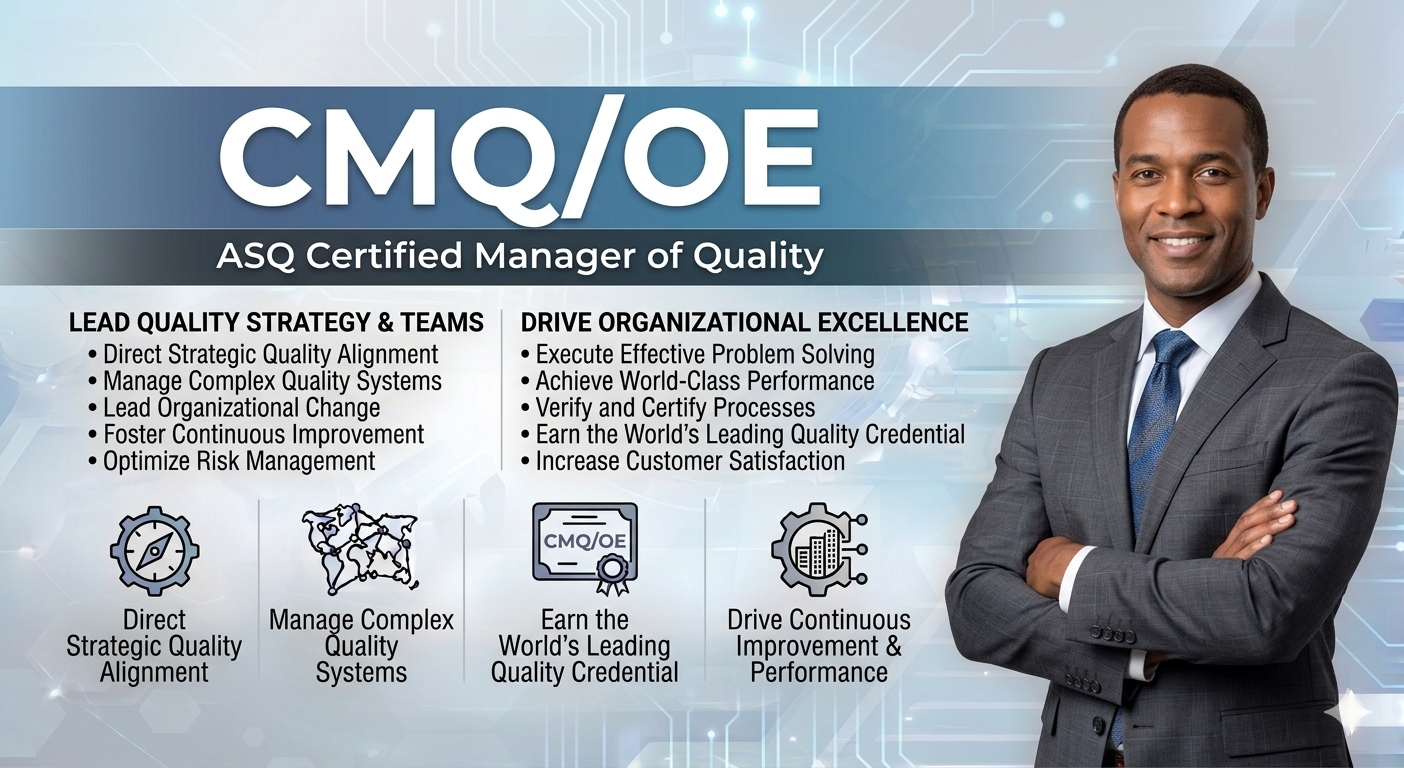
Certified Manager of Quality/ Organizational Excellence (CMQ/OE)
The Certified Manager of Quality/Organizational Excellence (CMQ/OE) is the pinnacle management credential from the American Society for Quality (ASQ). This certification transitions technical quality professionals into strategic leaders capable of driving organizational change and long-term excellence.
5/5
★
★
★
★
★


Overview
The CMQ/OE certification validates a professional’s ability to lead and manage quality improvement initiatives in organizations of any size. It focuses on the strategic side of quality—integrating leadership, strategic planning, and supply chain management with traditional quality tools to improve productivity and customer satisfaction.
Prerequisites
ASQ requires a total of 10 years of work experience in one or more areas of the Body of Knowledge. However, education waivers can significantly reduce this requirement:
Education Level | Experience Waived | Remaining Experience Needed |
No Degree (Diploma) | 1 Year | 9 Years |
Associate Degree | 2 Years | 8 Years |
Bachelor’s Degree | 4 Years | 6 Years |
Master’s or Doctorate | 5 Years | 5 Years |
Decision-Making Requirement: At least 5 years of the total experience must be in a “decision-making” position (responsible for defining, managing, or controlling processes/teams).
Scope
The training covers seven core domains updated for the 2026 Body of Knowledge:
- Leadership: Organizational structures, leadership challenges, and team processes.
- Strategic Plan Development & Deployment: Business environment analysis and resource allocation.
- Management Elements and Methods: HR management, financial tools (ROI/NPV), and risk management.
- Quality Management Tools: The 7 classic tools, Lean, and Six Sigma methodologies.
- Customer-Focused Organizations: CRM, customer segmentation, and satisfaction metrics.
- Supply Chain Management: Supplier selection, risk, and performance improvement.
- Training and Development: Needs analysis, curriculum design, and effectiveness evaluation.
Target Audience
- Quality Managers & Directors: Seeking a professional benchmark for leadership.
- Process Improvement Leaders: Driving Lean and Six Sigma at the enterprise level.
- Management Consultants: Specializing in organizational excellence.
- Senior Quality Engineers: Preparing to transition into executive management roles.
Certifications
- Credential: Certified Manager of Quality/Organizational Excellence (CMQ/OE).
- Examination Format: * Computer-Based: 180 multiple-choice questions (165 scored).
- Duration: 4 hours and 18 minutes.
- Maintenance: Must earn 18 Recertification Units (RUs) every three years to maintain the credential.
Examination & Membership Fee
ASQ members receive a significant discount on the examination fee.
Category | ASQ Member Fee | Non-Member Fee |
Certification Exam | $485 USD | $585 USD |
Retake Fee | $385 USD | $385 USD |
ASQ Membership | $179 USD / year | N/A |
FAQ's
Q: Is the exam open-book?
A: Yes. ASQ allows you to bring your own reference materials (handbooks, primers) into the testing center, provided they are bound.
Q: When will the 2026 Body of Knowledge be tested?
A: The updated 2026 BoK is officially tested starting in the July 2026 examination window.
Q: Does the decision-making experience need to be “Quality Manager” in title?
A: No. It can be any role where you had the authority to control a process, budget, or team (e.g., Project Manager, Engineering Lead).
Q: What is the passing score?
A: ASQ uses a scaled score. You need to achieve 550 out of 750 points to pass.
Module 1: Leadership Foundations: Styles (Transformational vs. Transactional) and Ethics.
Module 2: Strategic Planning: Hoshin Kanri, SWOT, and the Balanced Scorecard.
Module 3: Business Elements: Financial statements (Balance Sheets, Income Statements) for managers.
Module 4: Technical Quality: Process capability ($C_p, C_{pk}$), SPC, and Root Cause Analysis.
Module 5: Global Supply Chain: Supplier auditing, partnerships, and logistics.
Module 6: Change Management: Kotter’s 8 Steps and overcoming organizational resistance.
NEW VERSION
This Transition Guide is designed to help students navigate the shift from the legacy 2019 Body of Knowledge (BoK) to the new 2026 version.
While the core seven sections remain, the depth of cognitive levels and modern topics (like AI and Hybrid Work) have been significantly updated for exams starting July 1, 2026.
1. High-Level BoK Comparison (2019 vs. 2026)
The weightage of questions has shifted to reflect the increasing importance of quality management in digital and globalized supply chains.
BoK Section | 2019 Questions | 2026 Questions | Key Change |
I. Leadership | 28 | 28 | Stable weight; updated for EI. |
II. Strategic Plan Development | 22 | 23 | +1; Added PESTLE & AI Strategy. |
III. Management Elements | 31 | 26 | -5; Streamlined (Removed Baldrige). |
IV. Quality Management Tools | 30 | 31 | +1; Added 8D, A3, SIPOC, and TPM. |
V. Customer-Focused Org | 21 | 22 | +1; Added Contractual Requirements. |
VI. Supply Chain Management | 17 | 18 | +1; Added Supplier Exit Strategies. |
VII. Training & Development | 16 | 17 | +1; Focus on Effectiveness. |
2. What’s New in the 2026 Version?
The 2026 update introduces concepts that reflect the modern quality leader’s reality:
Artificial Intelligence (AI): Managing AI projects, data integrity in AI, and cybersecurity as a managerial risk (replacing the more technical “machine learning” mentions).
Business Governance & ESG: Explicit inclusion of Environmental, Social, and Governance (ESG), anti-bribery, and conflict of interest.
Virtual & Hybrid Environments: Challenges in leading and communicating with remote teams across different time zones.
Emotional Intelligence (EI): Now a formal part of management theory requirements.
Operational Tool Expansion: Introduction of 8D, A3, SIPOC, and Is/Is Not analysis, and TPM (Total Productive Maintenance) within Lean.
3. What has been Removed or Consolidated?
To make room for modern topics, ASQ has retired several legacy models:
Excellence Models: Direct testing on the Malcolm Baldrige and EFQM models has been removed. They are now viewed through the lens of general organizational performance.
Kepner-Tregoe: This specific decision-making model is no longer explicitly required.
Administrative Trimming: Several organizational risk management subtopics were removed to focus on practical, situational leadership.
Individual
Corporate
Program Info
The course highlights:
- Duration 35 Hours
- Language English
- Level Advanced
- Mode Online/ Corporate
Reach out for DISCOUNTED FEE & Additional CORPORATE DISCOUNT.