
Category
Category
Certified Quality Engineer (CQE)
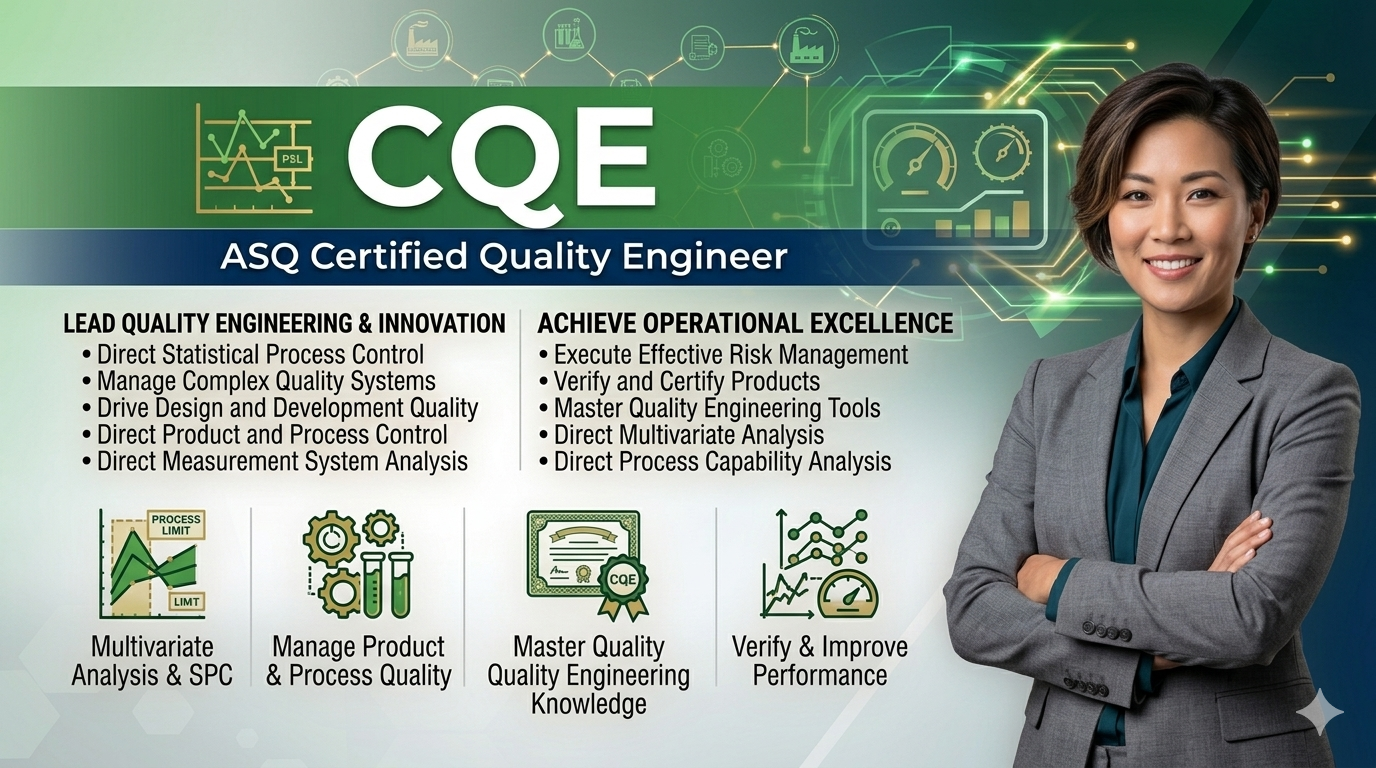
The Certified Quality Engineer (CQE) is a professional who understands the principles of product and service quality evaluation and control. Offered by the American Society for Quality (ASQ), this certification is widely considered the industry standard for engineers who specialize in statistical methods, quality systems, and process improvement.
5/5
★
★
★
★
★


Overview
1. Overview
The CQE body of knowledge covers the development and operation of quality control systems, the design and implementation of testing and inspection procedures, and the application of metrology and statistical methods to correct process quality. In 2026, the exam continues to emphasize the transition from purely technical oversight to a strategic role that includes risk-based thinking and digital transformation.
Prerequisites
ASQ requires a total of 8 years of on-the-job experience in one or more areas of the CQE Body of Knowledge. A minimum of 3 years of this experience must be in a “decision-making” role.
Education Waivers (Substitute for the 8-year requirement):
- Diploma from a technical/trade school: 1-year waiver.
- Associate Degree: 2-year waiver.
- Bachelor’s Degree: 4-year waiver.
- Master’s or Doctorate: 5-year waiver.
Example: If you have a Bachelor’s degree in Engineering, you only need 4 years of professional experience (with 3 of those years in a decision-making role) to be eligible.
Scope
The CQE exam is comprehensive and covers seven core domains:
- Management and Leadership: Quality philosophies, leadership principles, and the ASQ Code of Ethics.
- The Quality System: QMS design, documentation, and the Cost of Quality (CoQ).
- Product and Process Design: Quality function deployment (QFD), FMEA, and design verification.
- Product and Process Control: Metrology, Measurement System Analysis (MSA), and acceptance sampling.
- Continuous Improvement: Lean tools, Six Sigma, and Corrective/Preventive Action (CAPA).
- Quantitative Methods and Tools: Probability, distributions, statistical decision-making, and DOE.
- Risk Management: Risk assessment, mitigation, and ongoing monitoring.
Target Audience
- Quality Engineers: Seeking to validate their technical and statistical expertise.
- Process & Manufacturing Engineers: Responsible for stabilizing and improving production lines.
- Compliance & Regulatory Officers: Especially in high-stakes industries like Medtech or Aerospace.
- Reliability Engineers: Who want to strengthen their foundation in quality systems.
Certifications
- Credential: Certified Quality Engineer (CQE).
- Exam Format: 175 multiple-choice questions (160 scored, 15 trial).
- Exam Duration: 5 hours and 18 minutes.
- Open Book Policy: You are permitted to bring bound reference materials (like the CQE Primer or Handbook) and a non-programmable calculator.
- Recertification: Requires earning 18 Recertification Units (RUs) every three years.
Examination & Membership Fee
Becoming an ASQ member is highly recommended as the discount on the exam fee generally covers the cost of membership.
Fee Category | ASQ Member Fee | Non-Member Fee |
Initial Examination | $450 USD | $550 USD |
Retake Fee | $350 USD | $350 USD |
ASQ Membership (Annual) | $179 USD | N/A |
FAQ's
Q: Is there an engineering degree requirement for CQE?
A: No. While a degree is helpful and reduces the required years of experience, you can be certified based on experience alone (8 years).
Q: What is the “Decision-Making” requirement?
A: It refers to a role where you have the authority to define, execute, or control a process or project, or lead a team. You do not necessarily need to be a “Manager” in title.
Q: What is the passing score?
A: ASQ uses a scaled score. You need to achieve 550 out of 750 points to pass.
Q: How difficult is the CQE compared to Six Sigma Black Belt?
A: The CQE is often considered more technically rigorous regarding statistics and metrology, whereas the Black Belt focuses more on project management and enterprise-wide improvement.
- Module 1: Quality Management: Leadership, the history of quality (Deming, Juran, Crosby), and team dynamics.
- Module 2: Advanced Statistics: Hypothesis testing, ANOVA, and Regression analysis.
- Module 3: Statistical Process Control (SPC): Variable and attribute control charts ($X$-bar, $R$, $p$, $c$).
- Module 4: Metrology & Calibration: Precision, accuracy, and Gage R&R studies.
- Module 5: Product Safety & Reliability: MTBF, Bathtub curves, and life-cycle testing.
- Module 6: Lean & Six Sigma: DMAIC, Value Stream Mapping (VSM), and 5S.
Individual
Corporate
Program Info
The course highlights:
- Duration 35 Hours
- Language English
- Level Advanced
- Mode Online/ Corporate
Reach out for DISCOUNTED FEE & Additional CORPORATE DISCOUNT.