
Category
Category
Agile Certified Practitioner (PMI-ACP)
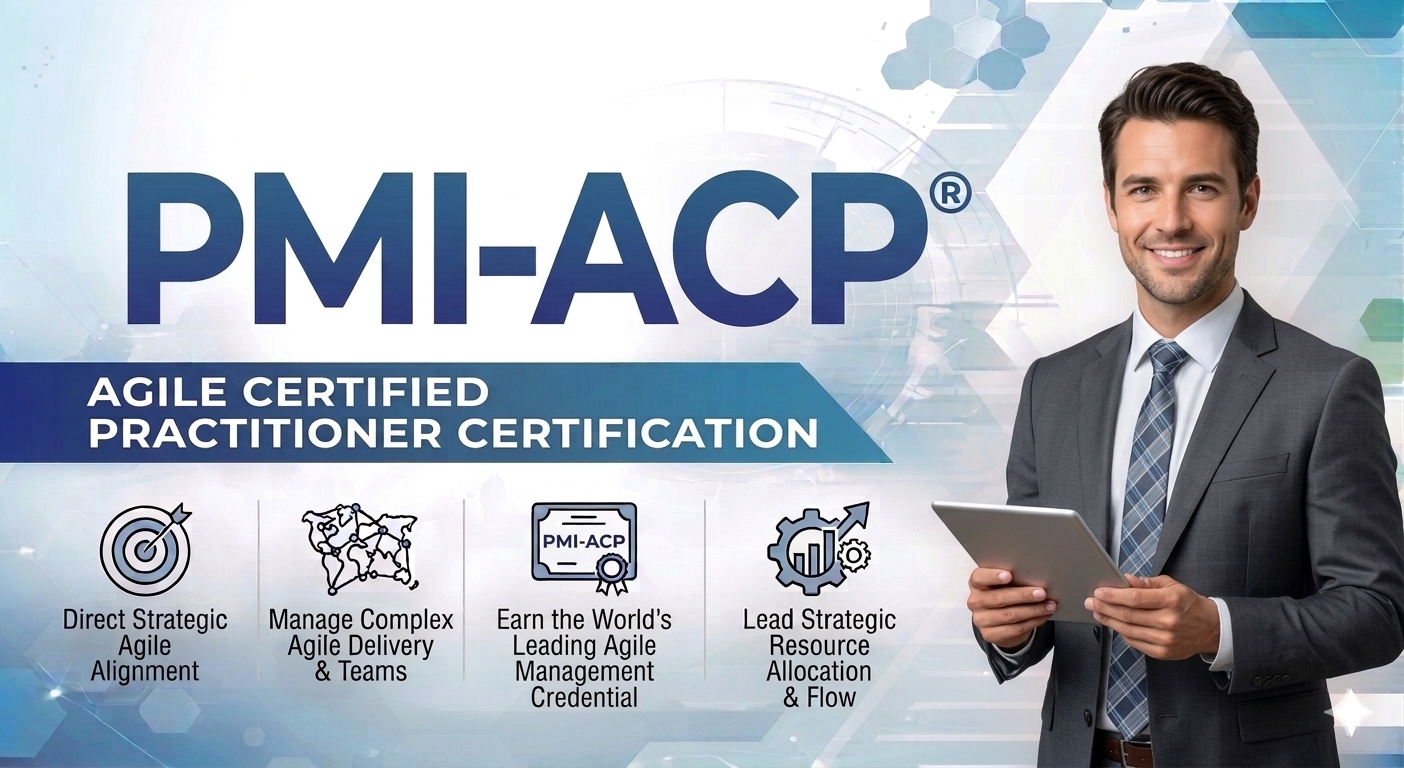
The PMI Agile Certified Practitioner (PMI-ACP) is one of the fastest-growing certifications in the project management world. It is unique because it doesn't just focus on one methodology (like Scrum); instead, it covers a broad spectrum of Agile approaches, including Kanban, Lean, Extreme Programming (XP), and Test-Driven Development (TDD).
5/5
★
★
★
★
★


Overview
The PMI-ACP is designed for professionals who work in organizations that utilize Agile principles to deliver projects. It validates an individual’s ability to lead agile teams, manage changing priorities, and foster a culture of continuous improvement. The certification goes beyond theory, testing the practitioner’s ability to apply Agile tools and techniques to real-world scenarios.
Prerequisites
To qualify for the PMI-ACP, you must meet the following three requirements:
- General Project Experience: 2,000 hours working on project teams. (If you hold a PMP® or PgMP®, these requirements are already met).
- Agile Project Experience: 1,500 hours working on agile project teams or with agile methodologies (this is in addition to the 2,000 hours of general project experience).
- Training in Agile Practices: 21 contact hours of formal education in agile practices.
Scope
The scope of the PMI-ACP training is defined by seven domains of practice:
- Agile Principles and Mindset: Understanding values and principles from the Agile Manifesto.
- Value-Driven Delivery: Delivering high-value results by producing high-priority increments.
- Stakeholder Engagement: Engaging with stakeholders through transparency and frequent feedback.
- Team Performance: Creating a “high-performance” environment of trust and empowerment.
- Adaptive Planning: Planning that is evolutionary and responsive to change.
- Problem Detection and Resolution: Identifying and solving impediments early.
- Continuous Improvement: Improving the product, the process, and the team through retrospectives.
Target Audience
- Agile Team Members: Developers, testers, and designers working in sprints.
- Project Managers & Team Leaders: Transitioning from traditional Waterfall to Agile.
- Scrum Masters & Product Owners: Looking for a broader credential than just “Scrum.”
- Technical Leads: Managing software or product development teams.
- Managers: Responsible for organizational agility and digital transformation.
Certifications
- Certification Name: PMI Agile Certified Practitioner (PMI-ACP)®.
- Validity: The certification is valid for 3 years.
- Renewal: To maintain the credential, you must earn 30 PDUs in agile topics every three-year cycle.
Examination & Membership Fee
Fees are structured based on PMI membership status.
Category | PMI Member Fee | Non-Member Fee |
Certification Exam | $435 USD | $495 USD |
Re-examination | $335 USD | $395 USD |
PMI Membership (Annual) | $139 USD | N/A |
Renewal Fee | $60 USD | $150 USD |
FAQ's
Q: How is PMI-ACP different from Certified Scrum Master (CSM)?
A: CSM is focused solely on the Scrum framework. PMI-ACP is an “agile umbrella” that covers Scrum, Kanban, Lean, XP, and more, making it more versatile for different industries.
Q: Is the exam based only on the PMBOK Guide?
A: No. The exam is based on the PMI-ACP Exam Content Outline (ECO) and refers to a list of 12 reference books, including the Agile Practice Guide.
Q: Can I use my Scrum Master training toward the 21 contact hours?
A: Yes, as long as the training covered agile principles and practices, it can count toward your 21-hour requirement.
Q: Is there an audit process?
A: Yes, like all PMI certifications, a percentage of applications are randomly selected for an audit to verify experience and contact hours.
A comprehensive PMI-ACP exam preparation course typically includes:
- Agile Methodologies: Deep dives into Scrum, Kanban, Lean, XP, and Crystal.
- Agile Tools: User Stories, Burn-down/Burn-up charts, Velocity, and Kanban boards.
- Estimation Techniques: Planning Poker, Affinity Estimating, and Ideal Time.
- Metrics: Lead time, Cycle time, and Cumulative Flow Diagrams (CFD).
- Leadership Skills: Servant leadership, Emotional Intelligence, and Coaching.
- Quality Practices: Continuous Integration, TDD, and Refactoring.
Individual
Corporate
Program Info
The course highlights:
- Duration 21 Hours
- Language English
- Level Advanced
- Mode Online/ Corporate
Reach out for DISCOUNTED FEE & Additional CORPORATE DISCOUNT.