
Category
Category
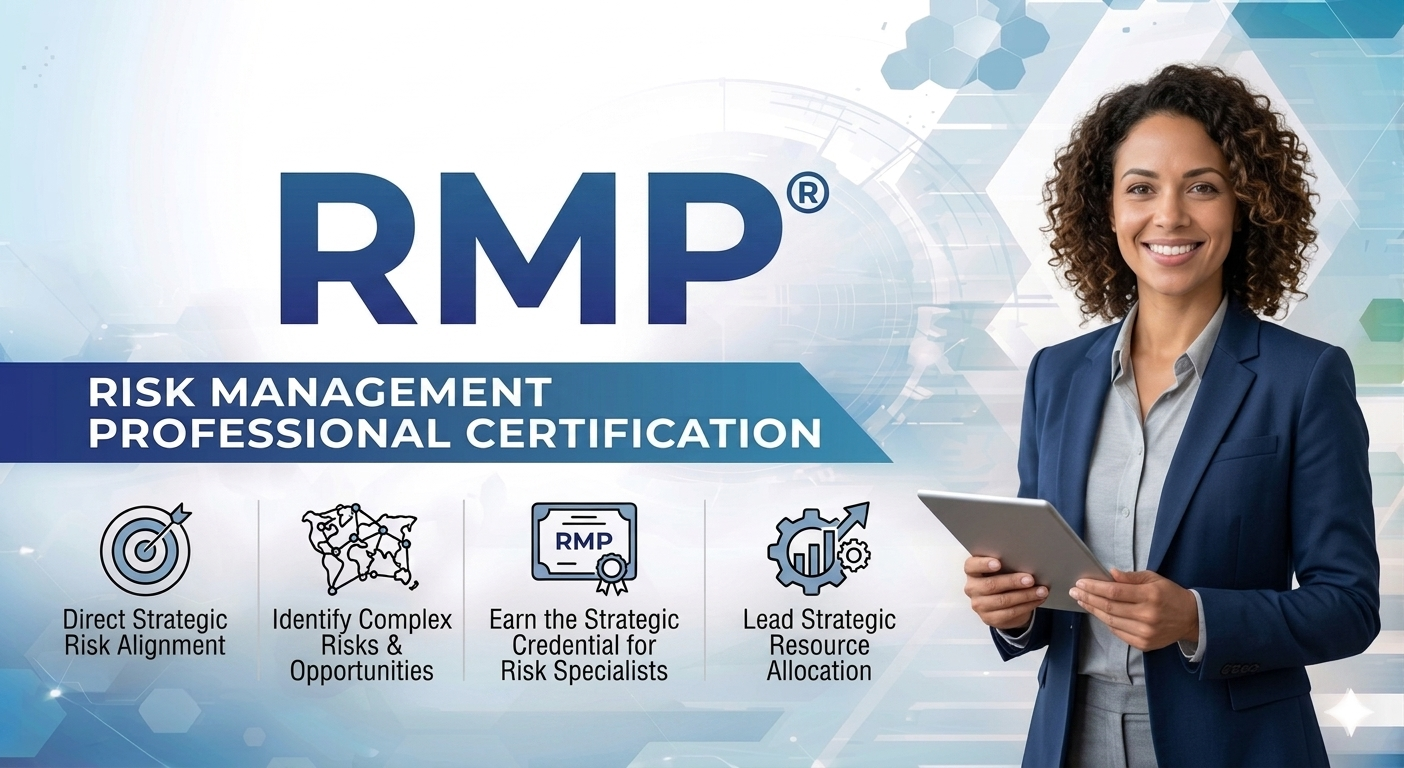
Risk Management Professional (PMI-RMP)
The PMI Risk Management Professional (PMI-RMP) is a specialized credential that demonstrates your ability to identify and assess project risks, mitigate threats, and capitalize on opportunities. In an increasingly complex business world, this certification sets you apart as an expert in proactive project stability.
5/5
★
★
★
★
★


Overview
The PMI-RMP training is designed to provide a deep dive into the framework of risk management based on the PMBOK® Guide and the Standard for Risk Management in Portfolios, Programs, and Projects. The course focuses on moving beyond simple “firefighting” to a structured approach of quantitative and qualitative risk analysis.
Key Learning Objectives:
- Developing a Risk Management Plan.
- Mastering risk identification techniques (SWOT, Delphi, Root Cause).
- Performing Qualitative and Quantitative Analysis (Monte Carlo simulations, Decision Trees).
- Planning and implementing risk responses.
Prerequisites
To sit for the PMI-RMP exam, you must meet one of the following sets of requirements:
Education Background | Project Risk Management Experience | Project Risk Management Education |
Secondary Degree (High School, Associate Degree) | 36 months within the last 5 years | 40 contact hours |
Four-Year Degree (Bachelor’s or Global Equivalent) | 24 months within the last 5 years | 30 contact hours |
Scope
The scope of the training covers the five primary domains defined by PMI:
- Risk Strategy and Planning: Defining risk thresholds and the management framework.
- Risk Identification: Uncovering potential events that could impact project objectives.
- Risk Analysis: Assessing the probability and impact of risks.
- Risk Response: Developing strategies (Avoid, Transfer, Mitigate, Accept/Exploit, Share, Enhance).
- Monitor and Close Risks: Tracking existing risks and identifying new ones throughout the project lifecycle.
Target Audience
This course is ideal for professionals who are responsible for identifying, assessing, and capturing risk across large-scale projects, including:
- Project and Program Managers
- Risk Management Consultants
- Line Managers
- Project Coordinators and Analysts
- Professionals aiming to transition into specialized risk roles.
Certifications
5. Certifications
Upon successful completion of the training and passing the PMI exam, you are awarded the PMI Risk Management Professional (PMI-RMP)® designation.
- Maintenance: To maintain the certification, you must earn 30 Professional Development Units (PDUs) in risk management topics every three-year cycle.
Examination & Membership Fee
Fees are subject to change by PMI. Below are the standard global rates:
- PMI Member Fee: $520 USD
- Non-Member Fee: $670 USD
- PMI Membership: Approximately $129 USD/year (plus a $10 application fee).
- Note: It is usually more cost-effective to become a member before paying for the exam.
FAQ's
Q: How long is the PMI-RMP exam?
A: The exam consists of 115 multiple-choice questions and you have 2.5 hours to complete it.
Q: Is the RMP harder than the PMP?
A: It isn’t necessarily “harder,” but it is much more specialized. While the PMP covers a broad range of project areas, the RMP requires a deeper technical understanding of mathematical risk modeling and analysis.
Q: Can I take the exam online?
A: Yes, PMI offers the option to take the exam via an online proctored testing (OPT) environment or at a physical Pearson VUE testing center.
Q: Does the training include the “contact hours” required for the application?
A: Yes, standard PMI-RMP training programs are designed to provide the 30–40 contact hours needed to qualify for the exam.
Individual
Corporate
Program Info
The course highlights:
- Duration 25-30 Hours
- Language English
- Level Advanced
- Mode Online/ Corporate
Reach out for DISCOUNTED FEE & Additional CORPORATE DISCOUNT.