
Category
Category
ISO 22301 BCMS Lead Auditor
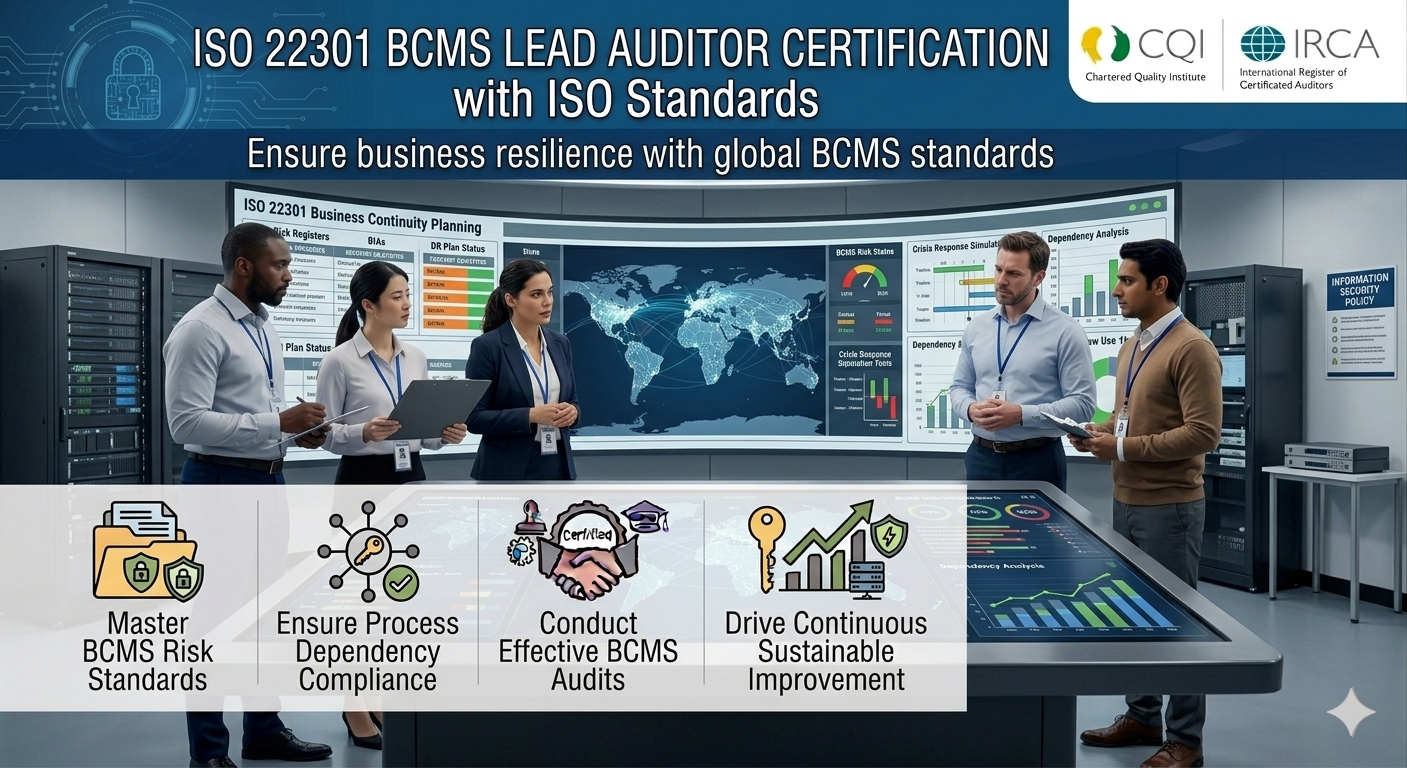
The ISO 22301 Lead Auditor course is the essential qualification for professionals focused on organizational resilience. Aligned with CQI-IRCA (Course ID: PR315/PR325), this training provides the expertise to audit a Business Continuity Management System (BCMS), ensuring that organizations can respond to, and recover from, major disruptions like cyber-attacks, pandemics, or natural disasters.
5/5
★
★
★
★
★



Overview
This 5-day (40-hour) intensive program teaches the principles of business continuity and the auditing techniques required to verify compliance with ISO 22301:2019. The course is heavily focused on the “Protect-Respond-Recover” cycle and the implementation of a robust management system.
Key Learning Objectives:
- BIA & Risk Assessment: Auditing how organizations identify critical functions through Business Impact Analysis (BIA).
- Continuity Strategies: Evaluating the effectiveness of recovery strategies and business continuity plans (BCPs).
- Audit Leadership: Leading an audit team through the complexities of disaster recovery and resilience testing.
- ISO 19011 Guidelines: Applying international auditing standards to the BCMS context.
The New Version: ISO 22301:2026/27
ISO 22301 is currently entering its next revision cycle. While the 2019 version is the current standard, ISO 22301:2026 (or early 2027) is anticipated to bring significant updates.
Anticipated Course Content Changes:
- Climate Resilience (Amendment 1): Mandatory integration of climate change as a core threat to business continuity (Clause 4.1).
- Supply Chain Resilience: Stricter auditing of “Just-in-Time” dependencies and third-party resilience.
- Digital & Cyber Continuity: Enhanced focus on auditing the convergence of BCMS with cybersecurity and digital transformation.
- Organizational Resilience (ISO 22316): Alignment with broader organizational resilience frameworks, moving beyond just “recovering” to “thriving” after disruption.
- Crisis Communication: Auditing the effectiveness of modern communication tools and social media management during an incident.
Prerequisites
CQI-IRCA expects delegates to have foundational “prior knowledge” before attending:
- Knowledge of ISO 22301: Familiarity with the terms and requirements of the 2019 standard.
- BCM Concepts: Understanding the concepts of RTO (Recovery Time Objective) and RPO (Recovery Point Objective).
- Management Systems: A solid grasp of the Plan-Do-Check-Act (PDCA) cycle and High-Level Structure.
Scope
The training covers the specific auditing requirements for a resilience-focused management system:
- Context & Leadership: Auditing organizational boundaries and top management commitment to resilience.
- BIA & Risk Assessment: Assessing the technical accuracy of impact analyses.
- Business Continuity Plans: Verifying the practical viability of response and recovery procedures.
- Exercise Programs: Auditing how organizations test their plans (drills, simulations, tabletop exercises).
- Performance Evaluation: Reviewing internal audits and management reviews to ensure continual improvement.
Target Audience
- Business Continuity Managers & Practitioners: Responsible for organizational resilience.
- Risk & Security Managers: Overseeing integrated risk management frameworks.
- Disaster Recovery (DR) Professionals: Focused on IT infrastructure and service continuity.
- Management Consultants: Advising clients on crisis management and ISO compliance.
- Internal & External Auditors: Seeking to perform certified third-party audits.
Certifications
- Certificate of Successful Completion: Issued upon passing the continuous assessment and the online CQI-IRCA exam.
- Professional Registration: This certificate is the primary educational requirement to apply for the BCMS Lead Auditor grade with the CQI-IRCA register.
- Industry Standing: Recognized globally as the standard for professional business continuity auditors.
FAQ's
Q: What is the exam format?
A: The CQI-IRCA exam is an online proctored exam, typically lasting 1 hour and 45 minutes (or up to 2.5 hours depending on the provider). It is restricted open-book and uses situational, case-study-based questions.
Q: Is there a difference between BCMS and Disaster Recovery (DR)?
A: Yes. DR is typically focused on IT infrastructure, while BCMS covers the entire organization, including people, processes, physical facilities, and third parties.
Q: If I am certified in the 2019 version, will I need to retake the course?
A: No. Once the 2026/27 version is released, you will simply need to attend a 1-day “Transition Course” to update your certification.
Q: Can I take this course if I don’t have an IT background?
A: Absolutely. ISO 22301 is a business-wide management standard. While IT is a component, the audit focuses on the governance and management of continuity across all departments.
Q: What is a passing score?
A: You must achieve a minimum score (typically 50%) in each of the exam domains and an overall score of at least 50% to pass.
Module 1: BCMS Fundamentals and Context
Module 2: Planning and Business Impact Analysis (BIA)
Module 3: Implementation and Continuity Procedures
Module 4: Lead Auditor Roles and Responsibilities
Module 5: The Audit Process (Preparation & Performance)
Module 6: Reporting and Corrective Actions
- Download the exam course outine
Individual
Corporate
Program Info
The course highlights:
- Duration 40 Hours
- Language English
- Level Advanced
- Mode Online/ Corporate
Reach out for DISCOUNTED FEE & Additional CORPORATE DISCOUNT.