
Category
Category
ISO 9001 QMS Lead Auditor
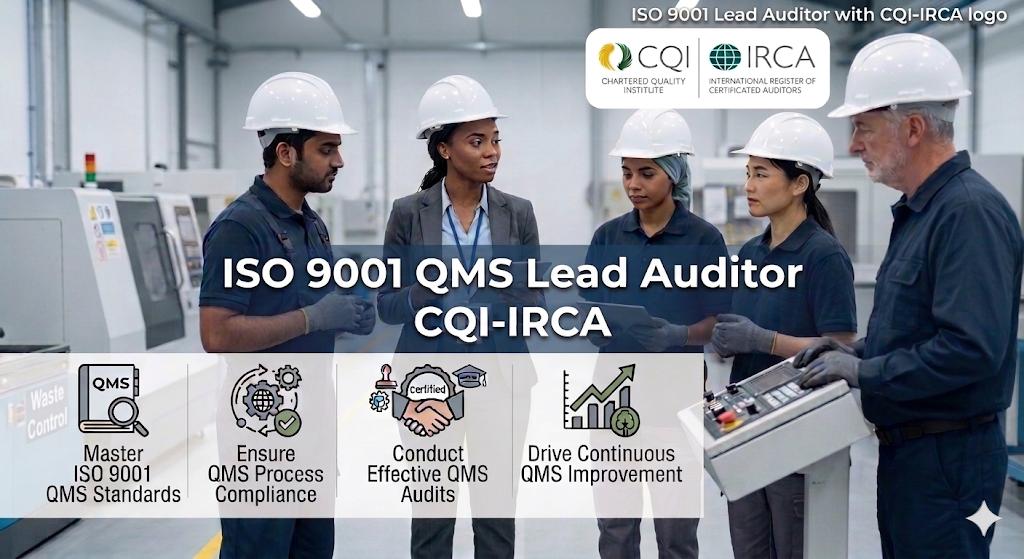
The ISO 9001:2015 Lead Auditor course is the gold standard for quality professionals. Aligned with CQI-IRCA (Course ID: PR328), it provides the qualification needed to perform high-stakes third-party audits for certification bodies, as well as second-party (supplier) and first-party (internal) audits.
5/5
★
★
★
★
★


Overview
This 5-day (40-hour) intensive program focuses on the “Process Approach” and “Risk-Based Thinking.” It teaches you not just to check boxes, but to evaluate how a Quality Management System (QMS) contributes to an organization’s strategic goals and customer satisfaction.
Key Learning Objectives:
- Audit Leadership: Managing the entire audit cycle according to ISO 19011.
- Clause Analysis: Deep dive into ISO 9001:2015 requirements from an auditor’s perspective.
- Evidence Gathering: Mastering interview techniques and “audit trails.”
- Reporting: Writing professional non-conformity reports (NCRs) and grading them (Major vs. Minor).
The New Version: ISO 9001:2026
The ISO 9001 standard is currently under revision. While ISO 9001:2015 is the current live version, ISO 9001:2026 is expected to be published in Q3 or Q4 of 2026.
Anticipated Course Content Changes:
- Climate Action: Explicitly addressing climate change as a mandatory “context of the organization” (Clause 4.1).
- Organizational Resilience: New emphasis on a company’s ability to absorb and recover from disruptions.
- Quality Culture: Transitioning from “managing compliance” to “leading a culture of quality” and ethical conduct.
- Emerging Technologies: Guidance on integrating AI, digitalization, and automated data monitoring into the QMS.
- Stakeholder Transparency: Increased focus on meeting the evolving needs of “interested parties” beyond just the direct customer.
Prerequisites
CQI-IRCA requires delegates to have “prior knowledge” to ensure the 5-day course can focus on auditing skills rather than teaching the standard from scratch.
- QMS Knowledge: Understanding the Plan-Do-Check-Act (PDCA) cycle.
- Standard Familiarity: A solid grasp of the clauses within ISO 9001:2015.
- Quality Principles: Knowledge of the 7 Quality Management Principles (Customer Focus, Leadership, Engagement of People, etc.).
Scope
The training covers the four main pillars of a professional audit:
- Preparation: Developing audit plans and process-based checklists.
- Execution: Conducting opening meetings, performing site tours, and gathering objective evidence.
- Closing: Conducting closing meetings and presenting findings to top management.
- Follow-up: Evaluating the effectiveness of corrective actions taken by the auditee.
Target Audience
- Quality Managers & Management Representatives: Responsible for maintaining ISO certification.
- Consultants: Looking to help clients implement or improve their QMS.
- Aspiring External Auditors: Professionals aiming to work for Certification Bodies (CBs).
- Supply Chain Leads: Those who need to audit vendors to ensure quality standards.
Certifications
- Training Certificate: Issued upon successful completion of the continuous assessment and the final exam.
- Professional Grade: This certificate is the primary requirement to apply for individual auditor grades (Associate, Auditor, or Lead Auditor) with the CQI-IRCA register.
- Validity: The training certificate is typically valid for 3 years for the purpose of initial IRCA registration.
FAQ's
Q: Is the exam open-book?
A: Yes, CQI-IRCA exams are typically “restricted open-book,” meaning you can use a clean copy of the ISO 9001 standard and your own course notes.
Q: If I get certified in 2015 now, will it be wasted when the 2026 version comes out?
A: Not at all. There is always a 3-year transition period (likely until late 2029). You will simply need to take a 1-day “Transition/Bridging Course” once the new version is released.
Q: Can the course be taken online?
A: Yes. Most providers offer Live Virtual Training (LVT) which is fully IRCA-accredited, including an online proctored exam.
Q: What is the passing mark for the exam?
A: You must pass both the continuous assessment (day-to-day workshops) and the final exam (usually requiring a 70% score).
Module 1: The Foundations of Quality Management
Module 2: Auditing Planning, Support & Risk
Module 3: Auditing Operational Processes
Module 4: Audit Leadership & ISO 19011 Lifecycle
Module 5: Performance Evaluation, Reporting & NCRs
- Download the exam course outine
Individual
Corporate
Program Info
The course highlights:
- Duration 35 - 40 Hours
- Language English
- Level Advanced
- Mode Online/ Corporate
Reach out for DISCOUNTED FEE & Additional CORPORATE DISCOUNT.