
Category
Category
ISO 13485 Lead Auditor Course
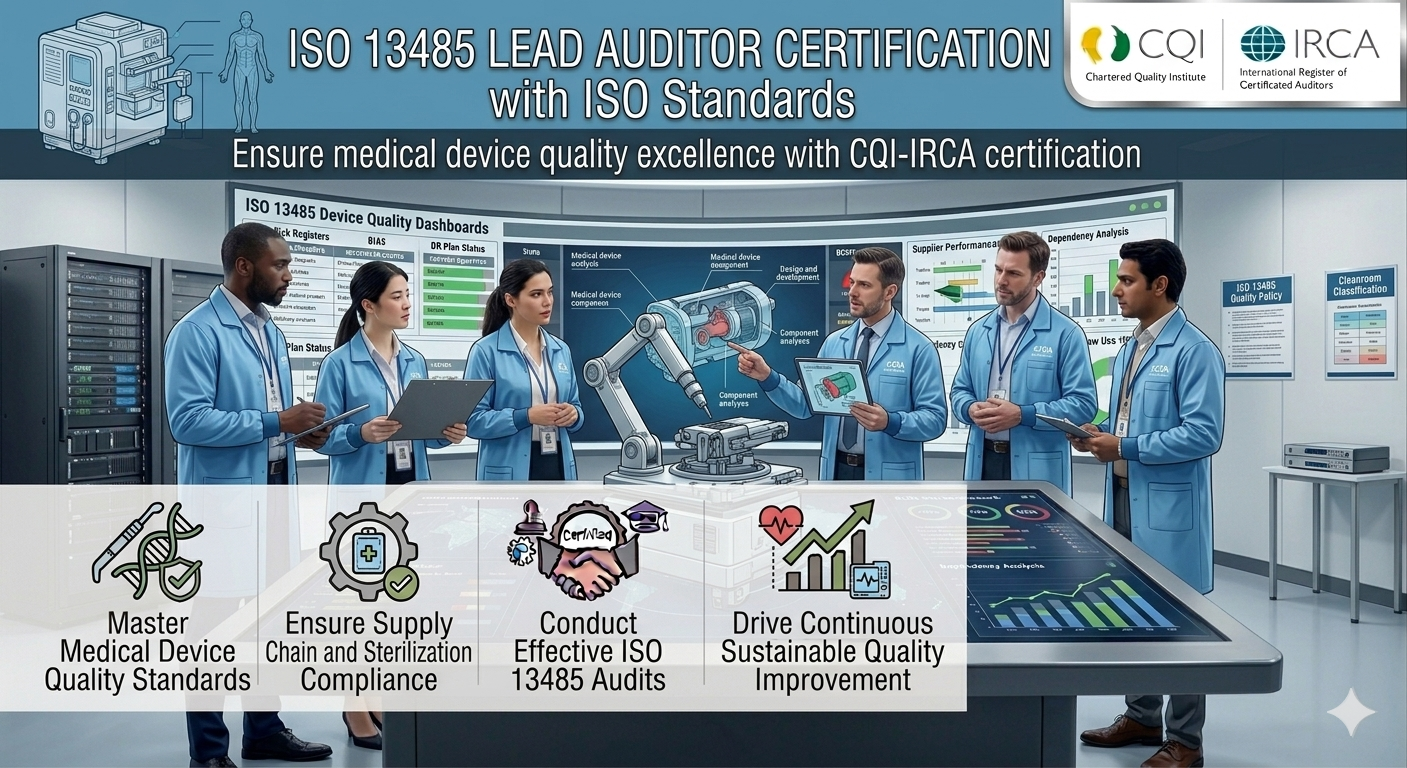
ISO 13485:2016 Medical Devices Auditor/Lead Auditor course is the specialized qualification for professionals in the medical device industry. Aligned with CQI-IRCA (Course ID: PR369), this training provides the technical expertise to audit a Quality Management System (QMS) where the stakes involve patient safety and global regulatory compliance.
5/5
★
★
★
★
★


Overview
This 5-day (40-hour) intensive program focuses on the requirements of ISO 13485:2016, emphasizing the importance of risk management and maintaining the effectiveness of the QMS. Unlike standard ISO 9001 audits, this training centers on the safety and efficacy of medical devices throughout their life cycle.
Key Learning Objectives:
- Regulatory Alignment: Understanding how ISO 13485 aligns with global regulations like the EU MDR/IVDR and FDA 21 CFR Part 820.
- Risk Management: Auditing the integration of ISO 14971 (Application of Risk Management to Medical Devices) within the QMS.
- Audit Leadership: Managing an audit team through sterile manufacturing, design, and distribution environments.
- Evidence Gathering: Verifying technical files, sterilization records, and clinical evaluation data.
The New Version: ISO 13485:2026/27
The medical device standard is currently entering a formal revision period to align with the latest global regulatory shifts. While the 2016 version remains active, ISO 13485:2026 is anticipated to be released in late 2026 or early 2027.
New Course Contents & Anticipated Changes:
- Climate Action (Amendment 1): Mandatory auditing of how climate change impacts medical device storage, supply chain stability, and raw material integrity (Clause 4.1).
- Software as a Medical Device (SaMD): Enhanced focus on auditing AI-driven software, cybersecurity, and data privacy in medical technology.
- Supply Chain Resilience: Stricter requirements for auditing sub-tier suppliers and managing disruptions in critical components.
- Post-Market Surveillance (PMS) Integration: Deeper alignment with EU MDR/IVDR requirements for continuous clinical data collection.
- Unique Device Identification (UDI): Formalized auditing of UDI implementation and labeling compliance.
Prerequisites
CQI-IRCA requires delegates to have a baseline of “prior knowledge” before attending:
- Knowledge of ISO 13485: Familiarity with the requirements of the 2016 standard.
- Quality Principles: Understanding the PDCA cycle and the concept of a management system.
- Medical Device Concepts: Basic awareness of the definition of a medical device and the concept of risk-based decision-making.
Scope
The training covers the specialized lifecycle of a medical device audit:
- Context & Leadership: Auditing the organization’s ability to meet regulatory and customer requirements.
- Product Realization: Assessing design controls, purchasing, and supplier evaluation.
- Process Controls: Verifying sterile barriers, cleanroom environments, and software validation.
- Measurement & Analysis: Auditing post-market surveillance (PMS), CAPA (Corrective and Preventive Action), and adverse event reporting.
- Reporting: Writing non-conformity reports (NCRs) that specifically highlight risks to product safety or regulatory breach.
Target Audience
- Quality & Regulatory Affairs (QA/RA) Managers: Responsible for device certification and compliance.
- Design & Development Engineers: Involved in creating technical documentation for medical devices.
- Production & Sterilization Managers: Overseeing sensitive manufacturing processes.
- Internal & External Auditors: Seeking to perform certified audits for manufacturers or notified bodies.
Consultants: Specializing in medical device market access and QMS implementation.
Certifications
- Course Certificate: Issued upon successful completion of the continuous assessment and the final IRCA examination.
- IRCA Registration: This certificate satisfies the training requirement to register as a Medical Devices QMS Lead Auditor with CQI-IRCA.
- Global Recognition: This credential is often required by Notified Bodies and Registrars for individuals performing official certification audits.
FAQ's
Q: Is the exam open-book?
A: Yes, CQI-IRCA exams are typically restricted open-book, allowing you to use a clean copy of the ISO 13485 standard and your course notes.
Q: Does this course cover FDA 21 CFR Part 820?
A: While the course focuses on ISO 13485, it highlights the areas where the two overlap, especially since the FDA is transitioning toward the Quality Management System Regulation (QMSR), which is largely based on ISO 13485.
Q: Do I need a background in medicine?
A: No. However, a technical background in engineering, biology, or pharmacy is extremely helpful given the technical nature of medical device clauses.
Q: What is the passing mark for the exam?
A: You must pass both the continuous assessment (workshops) and the final exam (usually requiring a score of 50% in each section and an overall average).
Q: Can I audit for a Notified Body after this course?
A: This course provides the educational qualification. To audit for a Notified Body, you will typically also need specific industry experience and a set number of supervised audit days.
Module 1: The Regulatory & Quality Landscape
Module 2: Technical Realization & Risk Management
Module 3: Audit Leadership & Planning
Module 4: Executing the Lead Audit
Module 5: Reporting, Non-Conformity, & Closing
- Download the exam course outine
Individual
Corporate
Program Info
The course highlights:
- Duration 40 Hours
- Language English
- Level Advanced
- Mode Online/ Corporate
Reach out for DISCOUNTED FEE & Additional CORPORATE DISCOUNT.