
Course Filter
Showing 1–12 of 25 results
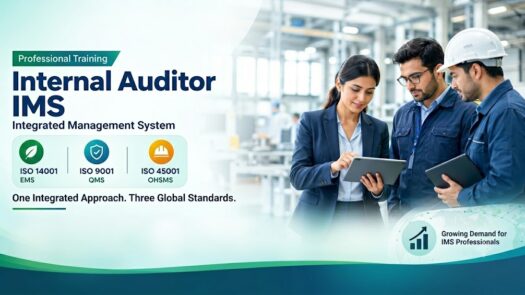
This three-day course prepares participants to plan, conduct, report and follow up integrated internal audits of a management system covering quality (ISO 9001:2026), environment (ISO 14001:2026) and occupational health and safety (ISO 45001:2018). It follows the ISO 19011 audit guidelines and includes the key changes in the 2026 editions of 9001 and 14001. Learning is practical, built around case studies, finding-writing workshops and a mock audit.
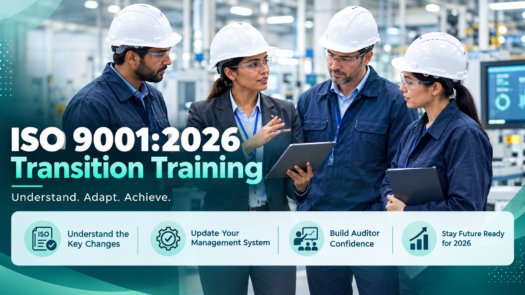
ISO 9001:2026 introduces a targeted yet vital update to the world’s benchmark Quality Management System standard. Key developments include explicit mandates for quality culture and ethical behavior, an operational decoupling of risks and opportunities, intensified controls around the management of change, and an extensively overhauled Annex A.
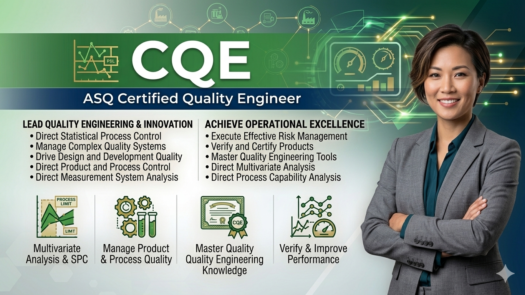
The Certified Quality Engineer (CQE) is a professional who understands the principles of product and service quality evaluation and control. Offered by the American Society for Quality (ASQ), this certification is widely considered the industry standard for engineers who specialize in statistical methods, quality systems, and process improvement.
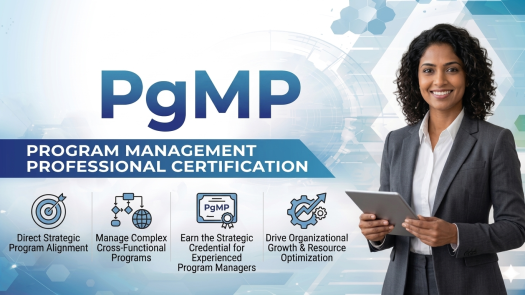
The Program Management Professional (PMP) is a prestigious credential for those who direct the strategic alignment of multiple, related projects. While the PMP focuses on the "how" of execution, the PgMP focuses on the "what" and "why" of organizational benefits and strategic goals.
The PMI Risk Management Professional (PMI-RMP) is a specialized credential that demonstrates your ability to identify and assess project risks, mitigate threats, and capitalize on opportunities. In an increasingly complex business world, this certification sets you apart as an expert in proactive project stability.
PMP Certification Training for professionals in GCC & India helps you prepare for the globally recognized Project Management Professional (PMP)® certification. The PMP® certification remains the world's leading project management credential in 2026, reflecting the latest industry trends, including Agile, Hybrid, and AI-driven project management methodologies.
The Portfolio Management Professional (PMI-PfMP) is the highest-level certification offered by PMI, designed for executives and senior practitioners who manage a collection of programs and projects aligned with an organization's strategic business objectives.
The PMI Construction Professional in Built Environment Projects (PMI-CP) is PMI’s premier certification for the construction industry. It addresses the specific challenges of capital projects, such as supply chain disruptions, onsite safety, and complex stakeholder coordination.
The PMI Agile Certified Practitioner (PMI-ACP) is one of the fastest-growing certifications in the project management world. It is unique because it doesn't just focus on one methodology (like Scrum); instead, it covers a broad spectrum of Agile approaches, including Kanban, Lean, Extreme Programming (XP), and Test-Driven Development (TDD).
The PMI Certified Professional in Managing AI (PMI-CPMAI) is a specialized certification launched to bridge the gap between traditional project management and the unique requirements of Artificial Intelligence (AI) and Machine Learning (ML). Unlike technical certifications for developers, it focuses on the methodology of managing data-centric, iterative projects.
The Certified Estimating Professional (CEP) is a flagship credential from AACE International. It validates a professional's ability to contribute to the economic evaluation of potential projects by developing budgets, project resource requirements, and value engineering while applying the Total Cost Management (TCM) framework.
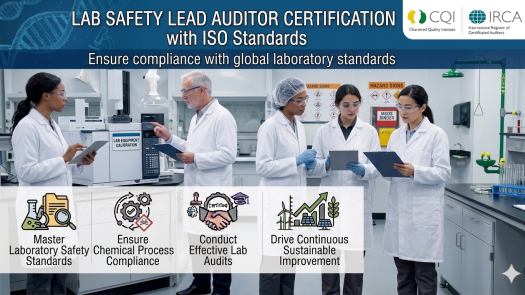
ISO 17025 Lead Auditor Course Training is the definitive qualification for professionals operating in testing and calibration laboratories. Aligned with CQI-IRCA (Course ID: PR325), it provides the specific technical and management system auditing skills required to verify laboratory competence and ensure the validity of results.